
up:: Start Here
Is this just Y2K again?
It’s a fair comparison, it comes up in nearly every conversation about this, and it doesn’t resolve the way most people expect.
The comparison is usually offered as a dismissal. Everyone panicked, nothing happened, so this is the same. That reading gets the history backwards, and once you correct it, the comparison becomes an argument for acting rather than against it.
Then there are three ways this one is structurally worse, and they’re the parts worth understanding.
The short version:
- Nothing happened at Y2K because people spent years making sure nothing happened. The U.S. alone spent an estimated $100 billion.
- The work is the same shape: inventory, prioritize, replace, test.
- Y2K had a date everyone could see. This has a threshold nobody will announce.
- Y2K’s damage waited for the deadline. This one’s damage started years ago, because data collected now is exposed later.
- Y2K ended. There was a morning after. This has no morning after, and silence is what failure looks like too.
What was Y2K, actually?
The defect was almost embarrassingly simple. For decades, programmers stored years as 2 digits, so 1999 was 99. When the calendar rolled over, the arithmetic would read 00 as 1900. Anything doing math on a date was suspect: interest calculations, expiration dates, scheduling systems, embedded controllers.
The deadline was midnight on January 1, 2000. It was the same midnight for everybody, visible years in advance, printed on every calendar on earth.
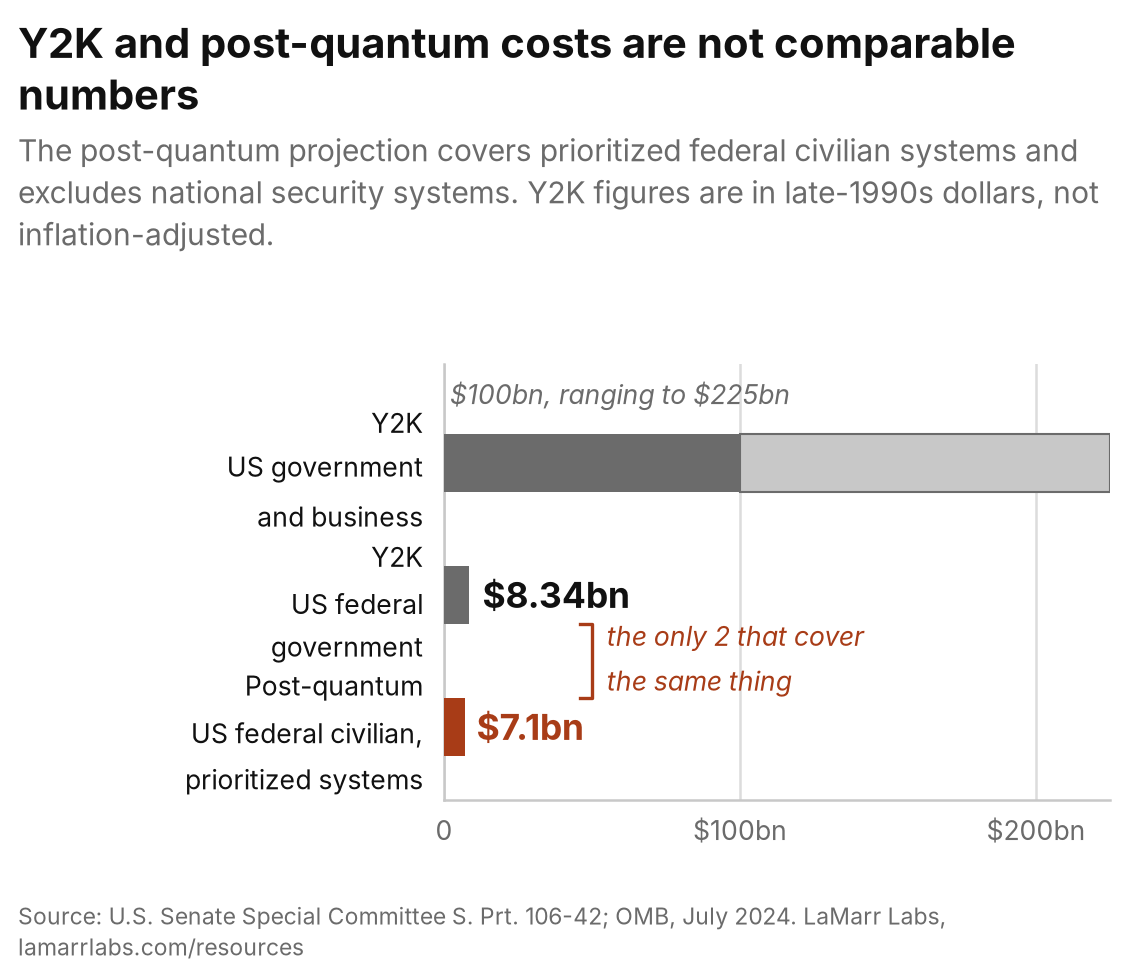
And the world took it seriously. The United States alone spent an estimated 8.5 billion of that by the federal government. Organizations inventoried systems nobody had examined in years, prioritized what mattered, fixed or replaced it, and tested against a clock everyone could see.
Source: U.S. Senate Special Committee on the Year 2000 Technology Problem, “Y2K Aftermath, Crisis Averted: Final Committee Report,” S. Prt. 106-42, February 29, 2000, govinfo.gov.
So was it overblown?
The Senate committee that studied it afterward concluded the opposite, in its own words: “It is the Committee’s judgment that the level of effort was justified and the expenditure of funds was indeed necessary.”
Midnight came, the lights stayed on, and within a few years the whole thing was being retold as an overreaction. That retelling reverses the causality. The disaster was averted because tens of thousands of teams spent years averting it.
Quiet success got remembered as evidence the problem was never real, and that memory is now a liability, because it’s the lens people bring to this one.
What does the comparison get right?
The work itself rhymes almost perfectly, and anybody who’s done one will recognize the other.
| Y2K | The quantum transition |
|---|---|
| Find every system doing date arithmetic | Find everywhere cryptography is used |
| Prioritize by what matters most | Prioritize by how long the data stays sensitive |
| Multi-year replacement program | Multi-year replacement program |
| Test to prove the fix took | Test to prove the fix took |
| Vendors and embedded equipment were the hard part | Vendors and embedded equipment are the hard part |
The behavioral lesson carries over too. Y2K sorted organizations into three groups: the ones that moved early, the ones that scrambled at the end and got away with it, and the holdouts who absorbed the damage. “Let’s wait until the standards settle” is the holdout position, and it sounds prudent right up until the sorting happens.
So when somebody says this is another Y2K, the productive answer is: yes, in every way that describes the work.
The comparison fails at the clock, and the clock is what the whole waiting strategy depends on.
Source: U.S. Senate Special Committee S. Prt. 106-42; OMB, July 2024.
The cost comparison fails in a quieter way, and it’s worth heading off because it comes up constantly. The 225 billion. The $7.1 billion post-quantum figure covers prioritized federal civilian systems and excludes national security systems entirely. Setting one against the other compares an economy to a subset of one government.
Break one: Y2K had a date. This has a threshold.
Y2K had a countdown the entire world could see. Everyone knew when, everyone knew what to fix, and everyone crossed the line together on live television.
This has the opposite structure, and the difference is the danger. There will almost certainly never be an announcement that a capable quantum computer exists. Whoever builds one first gains an advantage that survives only while it stays secret, and announcing it would trigger a global migration that destroys the advantage immediately.
That’s the doctrine intelligence services have followed every time they’ve held this kind of edge. See What does history tell us about broken codes?
So the question everyone asks, “when is Q-Day,” smuggles in an assumption that you’ll know when it happens. Y2K’s clock counted down to the event. This one, if it ever rings publicly at all, rings afterward.
Break two: the damage already started
Y2K’s damage was pinned to the calendar. The defect sat mostly inert until date arithmetic reached it, which is why starting in 1998 was survivable for the lucky.
This one bills the procrastination retroactively. Data collected today is exposed whenever the machine arrives, so for anything that has to stay secret across that gap, the exposure was locked in at the moment it was captured.
Y2K gave every procrastinator a grace period that expired all at once. This gives them a bill for the years they waited.
Break three: Y2K ended
There was a morning after. A verification. A moment the books closed and everyone could see what had and hadn’t happened.
This has no morning after. If the quiet decryption of collected archives began, the people affected would experience it as nothing at all. Which means the “see, nothing happened” retrospective that unfairly buried Y2K’s reputation can never even be run here.
Silence is what failure looks like too.
What should you take from the comparison?
That Y2K is the right model for the work and the wrong model for the deadline.
Use it when you’re explaining what a migration involves, because people who lived through Y2K already understand inventory, prioritization, and multi-year replacement programs. That’s useful shared vocabulary.
Drop it when you get to timing, because a visible global deadline and an unannounced threshold behave completely differently, and the waiting strategy that mostly worked for one is the losing move in the other.
Questions people ask
Didn’t some countries do almost nothing at Y2K and stay fine? That gets raised often, and comparisons across countries are muddied by very different levels of computerization and by remediation that happened inside multinational vendors regardless of local effort.
Isn’t the $100 billion evidence of waste? The committee that reviewed it concluded otherwise, and the systems that would have failed were identified and fixed by name rather than hypothetically.
Is anybody making money from this comparison? In both directions. Some vendors invoke Y2K to sell urgency, and some skeptics invoke it to dismiss the whole subject. Neither is a reason to avoid the comparison, and both are a reason to make it carefully.
What’s the strongest version of the skeptic case? It isn’t the Y2K comparison at all. See Is this overhyped?
Where to go next
- Is this overhyped? covers the stronger skeptical arguments.
- When is this going to happen? covers the actual timeline numbers.
- What does history tell us about broken codes? covers why no announcement is coming.
Go deeper into the technical detail
The technical version is Is Q-Day Another Y2K.
These open the Post-Quantum Field Guide, a separate site written for security professionals.
Last verified 2026-09-01 · Maintained by Addie LaMarr, LaMarr Labs.