
up:: What’s At Risk
What about my Bitcoin?
Really different from everything else in this section, and reported badly almost every time.
Everywhere else, the quantum problem is that someone reads information they collected years ago. With cryptocurrency it’s that someone forges your permission to spend, and takes the coins. That’s theft in the present rather than a privacy loss revealed later.
The good news is that exposure depends on something specific and checkable, and a lot of holders aren’t in the exposed category at all.
The short version:
- The break is on signatures, which are what authorize a spend. Not on mining.
- Your exposure depends on whether your public key is visible on the blockchain.
- Older address types and reused addresses publish that key. Fresh, unused modern addresses publish only a scrambled fingerprint of it, which gives an attacker nothing to work with.
- A Deloitte analysis counted over 4 million BTC, about 25% of supply at the time, in addresses with exposed public keys.
- Mining is fine. The quantum tool that touches mining gives only a modest speedup, and existing mining hardware outruns it.
- Coins in lost wallets can never be moved to safety, which is the part nobody can fix.
What exactly would an attacker do?
Spend your coins, using a signature they forged rather than one you made.
Owning cryptocurrency means holding a private key. When you spend, you produce a signature proving you hold it. The network checks that signature and moves the coins. That check is the entire ownership model.
A quantum computer running Shor’s method can work backwards from a public key to the private key that made it. With the private key, an attacker produces signatures indistinguishable from yours, and the network accepts them, because as far as it can tell they are yours.
Nothing gets decrypted. Nothing old gets read. Someone simply becomes able to spend from your address.
So is my Bitcoin exposed?
It depends on one question: has your public key ever appeared on the blockchain?
Exposed: older pay-to-public-key outputs, which publish the key directly, and any address you’ve reused after spending from it. The moment you spend, your public key becomes visible, so an address you’ve spent from and then sent more coins back to is exposed.
Not exposed, for now: a modern address you’ve received to and never spent from. Those publish only a scrambled fingerprint of the public key, and a fingerprint gives Shor’s method nothing to attack.
That distinction is why the answer to “is Bitcoin at risk” is neither yes nor no. Over 4 million BTC, about 25% of all supply at the time of Deloitte’s analysis, sits in addresses with exposed public keys, split between very early coins and reused addresses.
Source: Itan Barmes, Bram Bosch and Olaf Haalstra, “Quantum computers and the Bitcoin blockchain,” Deloitte, deloitte.com.
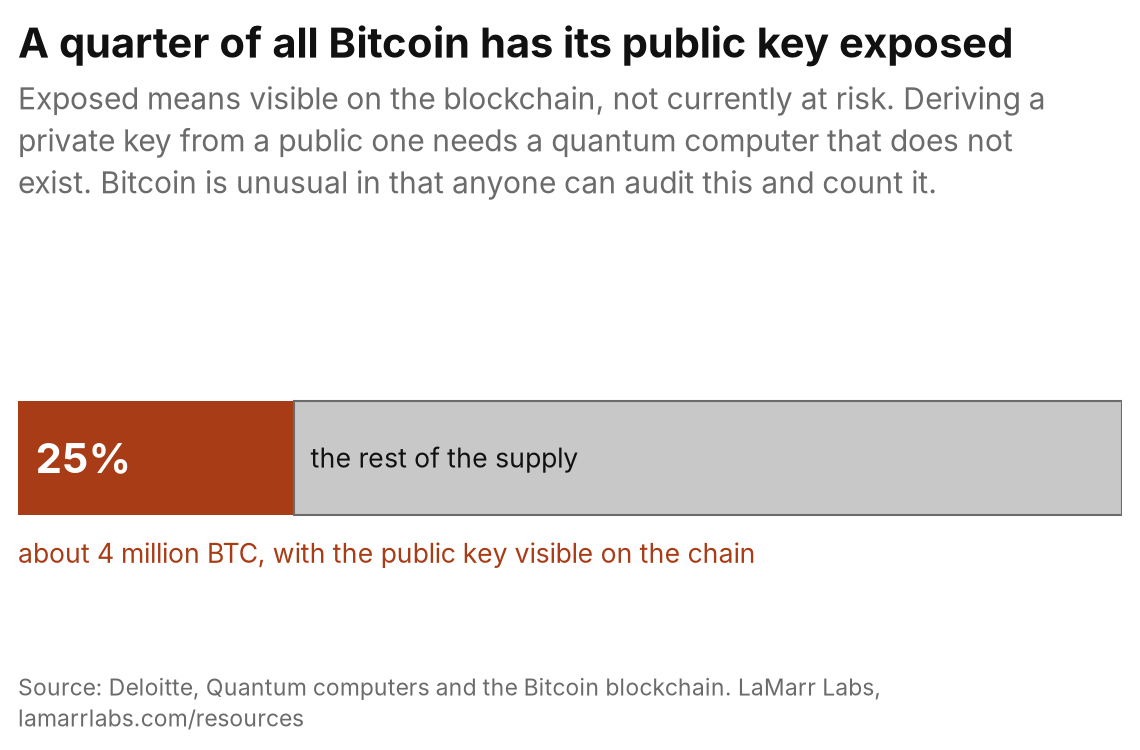
Source: Deloitte, Quantum computers and the Bitcoin blockchain.
Bitcoin is unusual here, and it’s worth saying why. For nearly every other kind of data, whether somebody has already copied it is unknowable. On a public blockchain the exposure is a measurable property of the ledger, so anyone can go and count it.
Which coins are exposed?
| Address situation | Is the public key visible? | Exposed? |
|---|---|---|
| Very early pay-to-public-key coins | Yes, published directly | Yes |
| An address you’ve spent from before | Yes, revealed at the moment of spending | Yes |
| An address you’ve spent from, then reused | Yes | Yes |
| A modern address you’ve only received to | No, only a scrambled fingerprint | Not yet |
| Coins in a lost or abandoned wallet | Often yes | Yes, and unfixable |
Isn’t mining the thing at risk?
No, and this is the most common error in coverage.
Mining runs on a different kind of mathematics, the half that survives a quantum computer. The quantum technique that touches it offers only a modest speedup, and purpose-built mining hardware already outruns what a quantum machine would contribute.
If you read an article claiming quantum computers will take over Bitcoin mining, that’s a reliable indicator the author hasn’t checked.
What can a holder actually do?
- Stop reusing addresses. Use a fresh address for each receipt, which most modern wallets do by default. This is the single highest-value habit, and it’s free.
- Move coins out of exposed addresses, particularly very old holdings in early address formats, into a fresh modern address you haven’t spent from.
- Keep your wallet software updated, so you get protocol changes when they arrive.
- Don’t buy a quantum-safe wallet product. The protections that matter will come through the protocol and through mainstream wallet software.
- Understand the seed-phrase problem. A backup of your recovery phrase copied off a network today is your coins, whenever someone reads it. Treat seed phrases as something that never touches an internet-connected device.
What about the coins nobody can move?
This is the unsolvable part, and it’s worth understanding.
A large share of the exposed supply sits in wallets whose owners are dead, lost their keys, or vanished. Those coins can never be moved to a safer address, because moving them requires the key nobody has.
That creates a policy problem the community hasn’t resolved. Some proposals would freeze or invalidate provably vulnerable coins before they can be stolen, which collides directly with the principle that nobody can take your coins. Others would leave them and accept the eventual theft. There’s no consensus, and the argument will get louder as the deadline approaches.
Questions people ask
Will Bitcoin just fix this? It can, and the mechanism exists: adopt post-quantum signatures through a protocol change. The hard part is coordination and the timeline, rather than the cryptography.
Should I sell? That’s an investment question rather than a security one, and nobody should be telling you what to do with your money based on this page.
What about Ethereum and everything else? Most chains rest on the same kind of signatures and face the same problem. Some are further along in planning than others. The structure of the risk is the same.
Is my hardware wallet safe? A hardware wallet protects your key from malware on your computer, which is a different threat. It doesn’t change whether your public key is visible on the blockchain.
What about exchanges? If an exchange holds your coins, its addresses and its security are the relevant question rather than yours, and that’s a fair thing to ask them. See the template.
Where to go next
- Are my passwords at risk? covers the vault question, which is related.
- What of mine is actually worth stealing? puts this in context.
- When is this going to happen? covers the timeline.
Go deeper into the technical detail
The technical version is Bitcoin and Blockchain Quantum Risk.
These open the Post-Quantum Field Guide, a separate site written for security professionals.
Last verified 2026-09-01 · Maintained by Addie LaMarr, LaMarr Labs.